Patient Intake
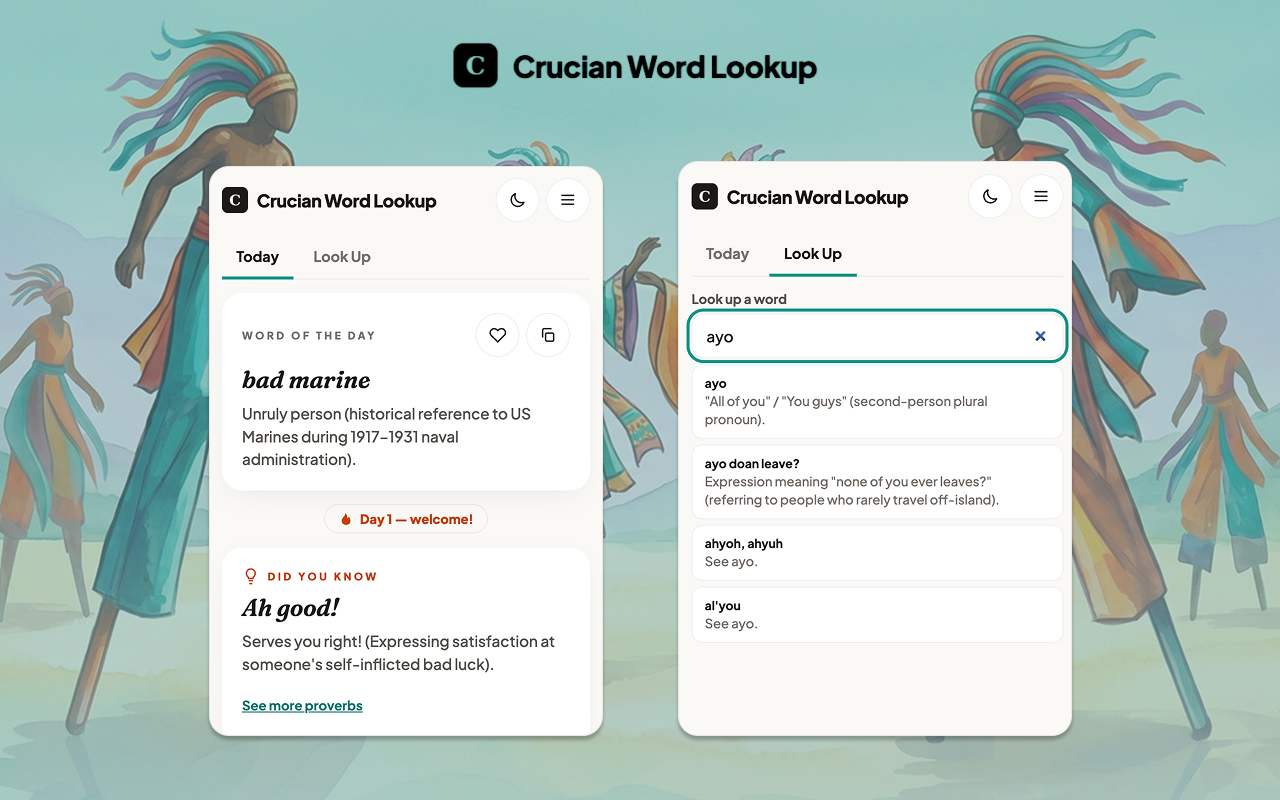
Design Lady LLC, independent, 2026, language technology. Crucian, the Virgin Islands Creole dialect of St. Croix, born from enslaved West Africans, Danish colonial rule, and centuries of Caribbean contact. Two surfaces, one language: a full web app and a browser extension.
Diagnosis
A deep-reference tool and a glanceable one aren't the same product at two sizes, they solve different moments. Someone sitting down to study grammar and proverbs needs depth. Someone mid-scroll hitting an unfamiliar word needs an answer in three seconds. Most preservation projects pick one surface and quietly underserve the other need.
Prescribing Physician
Sole designer and builder across both surfaces, working from one shared dataset rather than maintaining two separate content sources that could drift apart.
Treatment Protocol
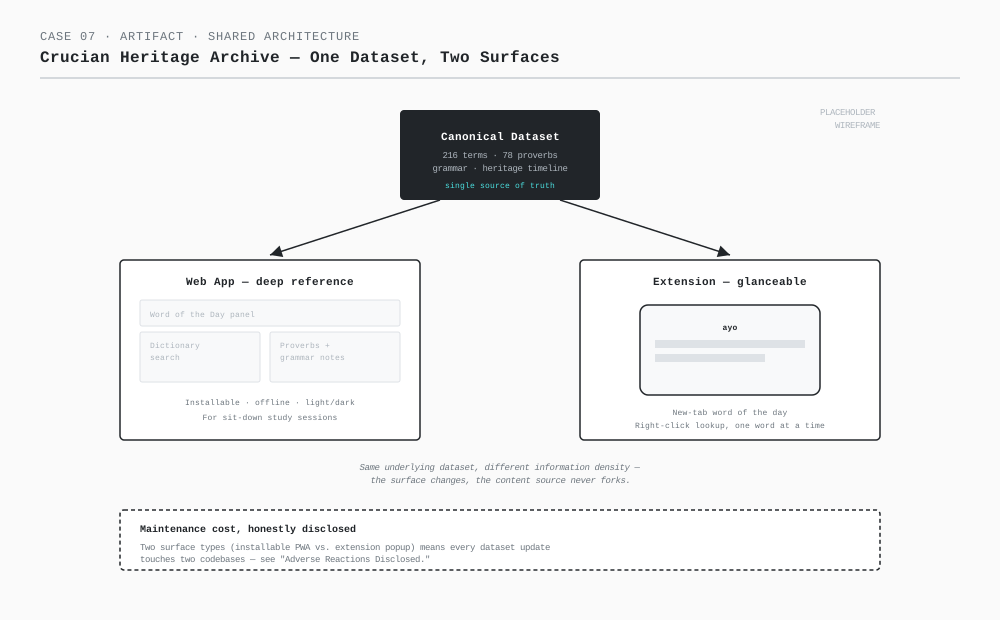
- Built the canonical dataset once (216 dictionary terms, 78 proverbs, grammar notes, a heritage timeline) as the single source of truth for both surfaces
- Designed the web app as the deep-reference surface: installable, works offline, light and dark themes, structured for sit-down study
- Designed the extension as the glanceable surface: word-of-the-day on every new tab, right-click-to-look-up inline, deliberately stripped down to the one moment it needs to serve
Dosage Limits
Both surfaces had to read from the identical dataset without diverging or doubling the maintenance burden, one content source, two presentation layers, not two projects. Deprioritized: user accounts and progress tracking on the web app, cut in favor of offline-first and zero-login, the right trade for a heritage tool over a gamified one.
Clinical Trial Artifacts
The shared-architecture decision this project actually rests on: one canonical dataset feeding two structurally different surfaces.
Efficacy Results
Live and installable across web (as a PWA) and both major extension stores (Chrome, Firefox). Archive covers 216 dictionary terms and 78 proverbs, plus grammar and heritage documentation.
Adverse Reactions Disclosed
Keeping feature parity across two structurally different surfaces, an installable PWA versus a lightweight extension popup, adds real ongoing maintenance overhead every time the dataset grows. A shared component library between the two would already have paid for itself.